Handrails

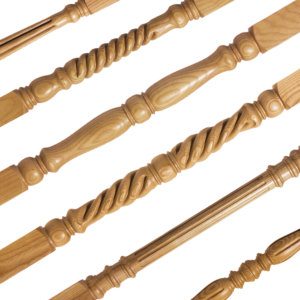
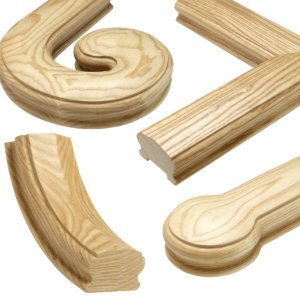
Explore a wide range of handrails for any staircase, from stately solid oak handrails to slender wall-mounted handrails and white primed bannisters that are ready to paint, select from our wide range to get the style you want, exactly as you’d like.

Shop online for fast delivery or visit our showroom to see our full range in person. With a variety of styles, finishes and sizes, it’s easy to find the perfect handrail to complement all styles of staircases, including metal and glass.

Finding the Right Handrail For Your Stairs

Choosing the right handrail depends on the overall look you would like to achieve. Grooved bannisters, which are all provided with infill, are tailored to suit the types of spindles we offer. They can be used with traditional wooden spindles, creating a warm and modern look, or used with glass panels or metal spindles for a clean-lined look.

Ungrooved handrails give you plenty of flexibility. They can be paired with spindle shoes to suit metal spindles, or brackets to hold glass panels securely in place. They can also be mounted directly to the wall using wall-mounted handrail brackets, creating a minimalist finish for enclosed hallways.

If you need help selecting the perfect handrail or just understanding technical terms, our team of experts are ready to guide you. You can also browse our FAQs below for step-by-step tips and advice.


Handrails FAQs

What is a grooved handrail?

A grooved handrail is a handrail that has a cut-out channel running along the underside of the rail in order to hold wooden or metal spindles, or glass panels. The width of the groove must be the same as the width of the spindle. For example, a 32mm grooved handrail will accept 32mm spindles. The groove for glass should be 1-2mm bigger than the actual panel for ease of fitting. 

What is the difference between solid and engineered handrails?

Solid handrails can either be made from one full piece of timber, or 2 to 3 pieces of solid timber laminated together. Whereas, engineered handrails consist of a piecemeal timber core with a thin wrap around the outside edge of the rail, providing excellent structural stability. Some engineered handrails can be finger jointed in length.

When should I get an ungrooved handrail?

An ungrooved handrail is ideal when the rail is being mounted directly to a wall, such as in an enclosed stairway, using wall-mounted brackets. It’s also the ideal choice if you’re using glass panels with brackets, or metal spindles secured with shoes. Ungrooved handrails should also be used when fitting Wellhope black metal spindles, where holes can be drilled into the rails to fix the spindles in place.

What height should a staircase bannister be?

Building regulations require that the handrail height should be between 900mm-1000mm above the pitch line of the stairs or floor. Additional conditions apply for commercial and public staircases. For shared access stairs, specific rules apply.  Please refer to Approved Document K, available on the gov.uk website, for your specific project.

Do handrails come supplied with infill?

All grooved handrails are provided with infill strips to make fitting spindles or glass easy and professional. Ungrooved handrails are not provided with infill. Infill strips are not the full length of the rail – they consist of multiple shorter pieces. The amount of infill provided will be suitable for the type of balustrade being fitted.

How many brackets do you recommend to support a wall-mounted handrail?

We recommend one bracket on each end plus an additional bracket every 1000mm of handrail for added support and stability. For example, with a 4200mm handrail we recommend 5 brackets.

When do I need a handrail?

A handrail must be provided if there are more than two steps in a staircase, or if there is a drop of more than 600mm. Staircases 1000mm or wider should have a handrail on both sides. For shared access or non-domestic properties, regulations may differ. Please refer to Approved Document K, available on the gov.uk website, for more information.